
Eurooooope!
One of the most important inventions in modern history was born right here. In 1989, at CERN, Tim Berners-Lee proposed something his boss described as "vague but exciting". That idea became the World Wide Web.
But here's the uncomfortable truth: Europe invented it, but the U.S. scaled it.
While Europe played it safe, the U.S. built the ecosystem — venture capital, a risk-taking culture, and relentless speed. Companies like Netscape, Amazon, and Google didn't just grow; they defined the internet.
And now we're hearing the same story again. Europe is behind in AI. Behind in software. Losing industrial ground. Losing control over its own digital infrastructure.
Maybe.
But there is a way forward. The answer has been in front of us all along, and we take it for granted: the computer.
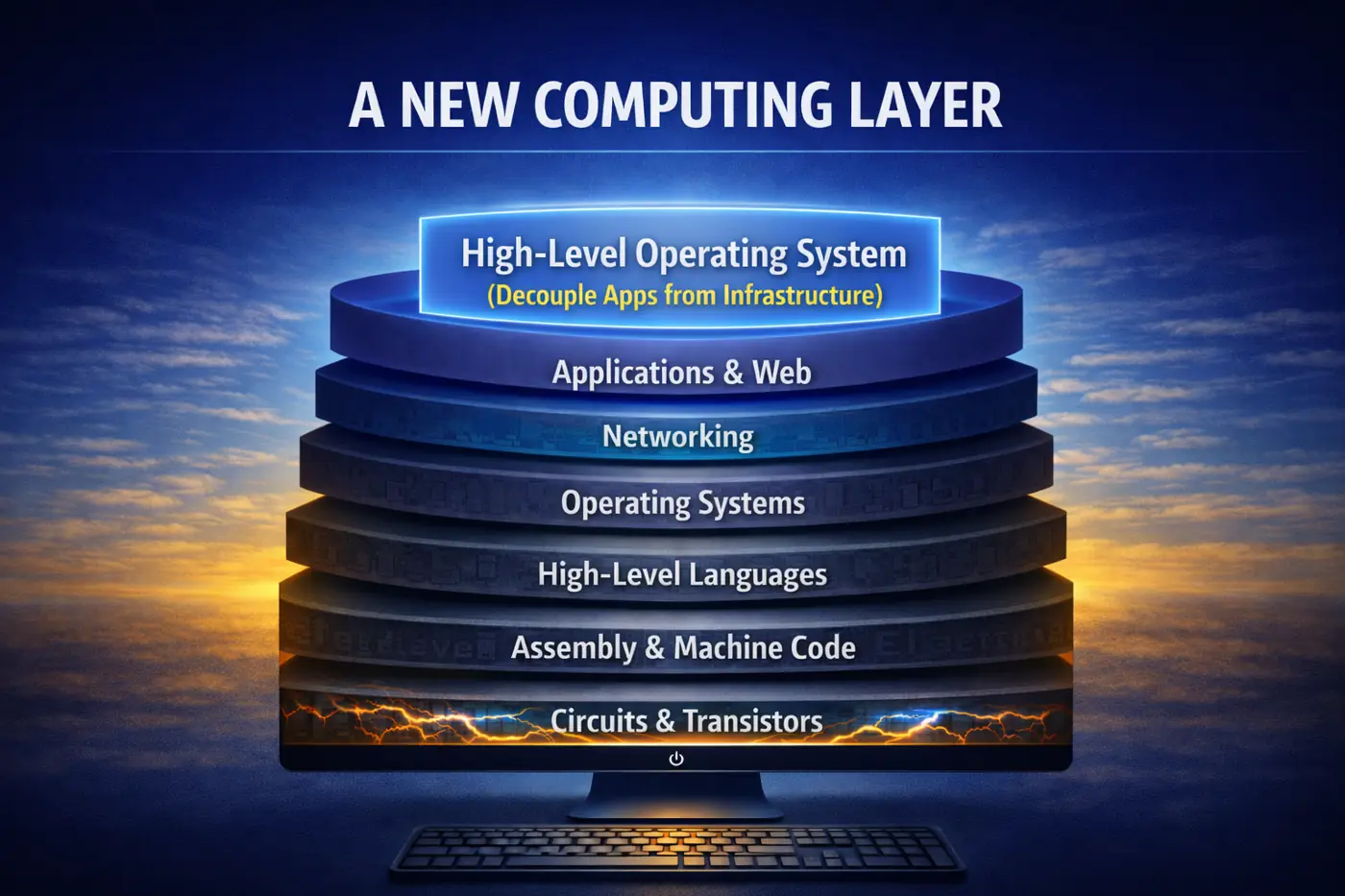
A computer only knows 0 and 1, yet we built entire worlds on top of that. We did it layer by layer: electricity, transistors, circuits, machine code, assembly, high-level languages, operating systems, networking — and applications and the web.
Each layer hides complexity and enables creation. That's the real invention: abstraction.
So here's a simple question: why stop here?
Today, most of our problems come from one thing — we are too tightly coupled to our infrastructure. Once we choose a stack, it becomes incredibly hard to change. Applications are tied to the cloud. Data gets locked in. Flexibility disappears.
What if we added one more layer?
Imagine a high-level operating system on top of existing operating systems. Not a metaphor — a literal one. A layer that provides the infrastructure and the stack, decoupling applications from the cloud. One that lets you switch providers anytime, and lets users decide exactly where their data lives.
This is what we are building at Web of Objects.
Building on the foundations of OOP and Domain-Driven Design, Web of Objects introduces an object-centric paradigm that abstracts infrastructure directly into the web, replacing fragmented silos with a universe of composable, interconnected objects.
And AI?
AI is powerful, but without context, it's blind.
A computer is not just computation; it is a system of components, and the processor is just one of them. That's what Large Language Models should become: a decoupled component inside a universal system. Models should be plugged in, swapped, and replaced, just like a CPU.
Web of Objects is being built in Europe. It is moving from prototype to MVP — and it needs support. But this is not just about technology. It's also about society.
Our ultimate vision is to create a united web society built on top of this new layer. But that's a story for another day.
Europe once invented something "vague but exciting" — and it changed the world.
It's time for Europe to do it again. But this time, we build it right, so it serves society, not just markets.
If this feels "vague but exciting", I'd love to hear your perspective.